
Simply send us a message via our contact form or write us an email directly. We will reply as quickly as possible and let you know if there is still a place available in your desired course. If everything aligns, we will ask for a deposit of 700 euros. As soon as we receive this, your place in the course is reserved and you can book your flights.
You fly to Ibiza and take the bus or a taxi to the port from there (“Al puerto para Formentera, por favor!”). At the port, you board the ferry to Formentera. We recommend buying only a one-way ticket initially – this keeps you flexible, and you can usually get a cheaper return ticket locally on Formentera. After the roughly 30-minute crossing, you reach the port of Formentera. The final 5 kilometers to our workshop in Sant Ferran can be covered easily by bus or taxi.
In and around Sant Ferran, there are numerous hostals, apartments, and Airbnb accommodations. We have a great connection with the nearby Hostal Pepe and can request rooms at special rates for you (depending on opening times, usually from May to October). Just let us know when registering whether you would like us to handle a reservation at Hostal Pepe for you or if you prefer to arrange your own accommodation. If you need help searching, we are happy to assist you.
As a rule, we work Monday to Friday in two blocks: mornings from 10:00 to 14:00 and, after an extensive Spanish siesta, from 18:00 to 21:30. On Saturdays, we only work half a day. The siesta gives you the ideal opportunity to go to the beach and enjoy the island – because relaxation is just as much a part of the course experience as the workshop time. Of course, we remain flexible within the group regarding exact schedules.
We stock all necessary standard materials for your instrument in our workshop. However, if you have specific hardware requests, simply speak to us in good time. We can either order your preferred parts for you in advance or you can bring them directly with you to the course.
To help you transport your instrument safely, we offer gig bags on site. However, these are usually not sufficient for an aircraft’s cargo hold, and taking them into the cabin is now subject to fees or restrictions with many airlines. For check-in as oversized baggage, we recommend a sturdy flight case. Upon request, we can order one directly for you at the start of the course so you don’t have to carry an empty case on your flight out. Transport is particularly straightforward for instruments with bolt-on necks.
Unfortunately, we cannot accommodate this within the framework of the course. On the one hand, a professional lacquering process requires several weeks of drying time; on the other hand, a dust-free lacquering finish cannot be organizationally achieved to the desired quality in our workshop rooms. French polishing with shellac would also exceed the time frame. By conviction, we therefore finish our instruments with a high-quality oil and wax finish. If you wish to add color or a special look to your instrument, we can stain the wood before oiling without any issues.
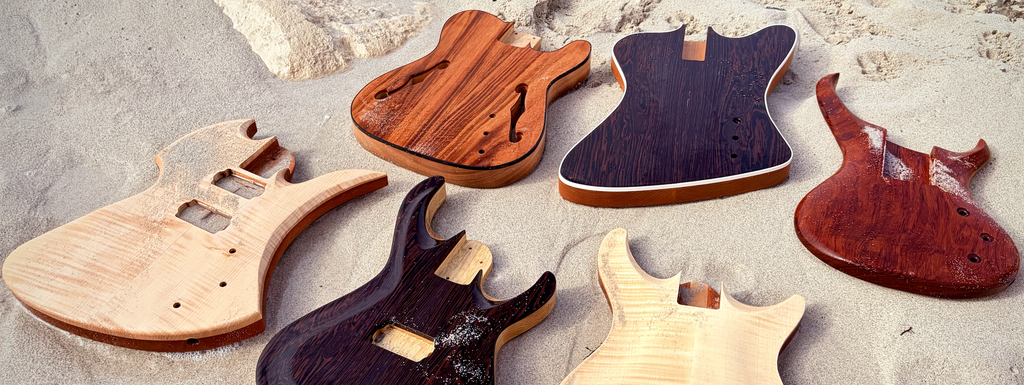
We exclusively use high-quality, properly seasoned tonewoods. You can choose from proven classics such as mahogany, mountain maple, American alder, or swamp ash. In addition, more exotic woods like bubinga, wenge, or courbaril are available. For fingerboards, we use fine woods such as ebony, rosewood, or grenadilla. We do not use pre-fabricated kits: you select your wood in its raw state and build your instrument entirely yourself from scratch.
If you own a piece of wood that is particularly close to your heart or offers a special look, you are welcome to use it after prior consultation. We will check together in advance whether the material is suitable for guitar building. The only requirement: the wood should ideally arrive on the island a few weeks before the course starts so that it can adjust to Formentera’s high humidity.
In general, you care for your self-built instrument just like any other guitar. There is only one small detail: the oil finish needs a few weeks after the course to cure completely. In addition, the wood adapts to the new climate at home. After about 8 to 10 weeks, it is the ideal time to refresh the wood surface with a fine oil sanding – exactly as you learned during the course with us.
No, unfortunately that is not possible with us. The delicate and fragile construction of acoustic instruments reacts very sensitively to Formentera’s high humidity. The wood would not survive the drastic climate differences during subsequent transport to the mainland without damage.
Your question isn’t listed here?
Then simply drop us a line.